
- An ISO 9001:2015 certified company
Testing Facilities
Testing
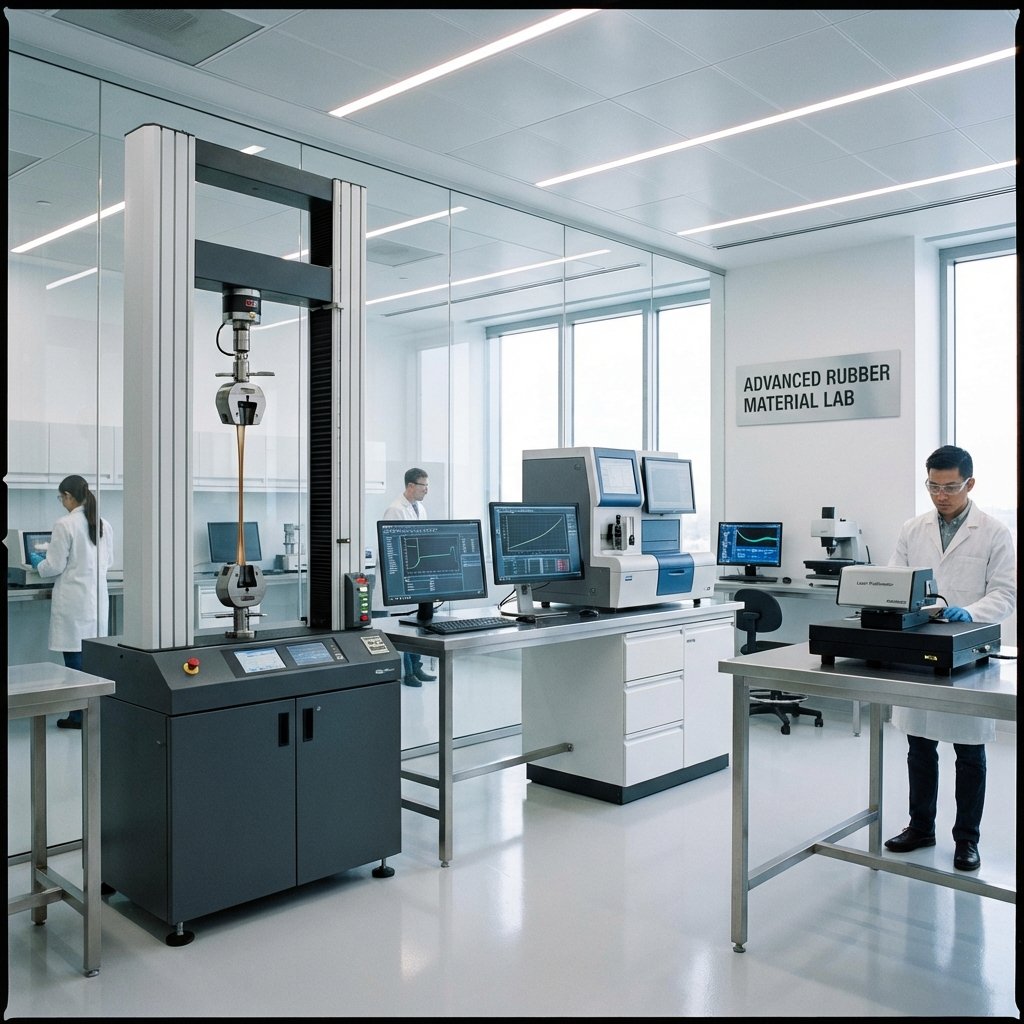
Comprehensive Rubber testing Facilities
Pafly Polymers operates a fully equipped in-house rubber and silicone testing laboratory designed to ensure that every product manufactured meets strict performance, safety, dimensional accuracy, and durability standards. Our advanced testing infrastructure supports material validation, compound analysis, dimensional inspection, and final product verification, enabling us to deliver high-performance industrial rubber components and silicone elastomer products for demanding applications.
By integrating quality testing directly within our manufacturing workflow, Pafly ensures complete material traceability, consistent product performance, and compliance with customer specifications and industry standards. This in-house capability significantly reduces dependency on external laboratories while enabling faster validation cycles, efficient quality control, and reliable supply of precision molded rubber parts.
100% Quality
Tested
Tested
Comprehensive Rubber and Silicone Material Testing Capabilities
Pafly’s testing laboratory is equipped with modern rubber testing instruments and precision measurement equipment used to evaluate both raw materials and finished elastomer products.
- Mechanical strength of rubber and silicone materials
- Hardness and elasticity of elastomer components
- Dimensional accuracy of molded parts
- Curing behavior and compound characteristics
- Thermal stability and material composition
These testing capabilities allow Pafly to manufacture precision industrial rubber seals, molded elastomer components, and silicone rubber parts that meet strict OEM quality requirements.
Key Testing Equipment at Pafly Polymers
Our in-house laboratory includes a wide range of specialized rubber testing and inspection equipment used for material characterization and dimensional verification.
- Universal Testing Machine (UTM): Used for tensile strength testing, elongation measurement, compression analysis, and tear resistance evaluation.
- Oscillating Disc Rheometer (ODR): Analyzes curing characteristics, scorch safety, and vulcanization behavior.
- Specific Gravity Meter: Verifies rubber compound density for consistency in formulation.
- Shore A Durometer: Measures hardness of rubber and elastomeric products.
- Profile Projector: Enables precision dimensional inspection of molded components.
- Coordinate Measuring Machine (CMM): Provides high-precision measurement of complex geometries.
- VMS: For precise, non-contact inspection to ensure dimensional accuracy and consistent quality.
- Muffle Furnace: Conducts high-temperature testing and thermal stability evaluation.
- Test Button Press: Prepares standardized rubber specimens for testing.
Multi-Level Quality Inspection System
Pafly Polymers follows a three-stage quality inspection system to ensure that every product manufactured meets strict engineering and dimensional requirements.
- Line Inspection: Continuous monitoring during production to maintain dimensional and process consistency.
- In-Process Inspection and Compounding Control: Monitoring specific gravity and curing properties at regular intervals.
- Final Dispatch Inspection: Comprehensive checks including dimensional accuracy and hardness verification before shipment.
ISO 9001:2015 Based Quality Management System
Pafly Polymers follows a process-driven Quality Management System aligned with ISO 9001:2015 principles, ensuring structured quality control across all operational stages.
- Incoming raw material inspection
- Compound validation and testing
- In-process production monitoring
- Final product inspection and verification
- Continuous improvement and process optimization
Test Certificates and Product Documentation
To ensure transparency and customer confidence, Pafly Polymers can provide test certificates and quality documentation for all manufactured products. These reports include material properties, hardness values, tensile performance, and dimensional verification, supporting the requirements of OEM manufacturers, engineering companies, and industrial clients.
Reliable Quality Testing for Industrial Rubber Components
Through a combination of advanced testing equipment, multi-level inspection procedures, and ISO-aligned quality systems, Pafly Polymers ensures that every product delivered meets strict performance, durability, and dimensional accuracy standards.
Our in-house testing capabilities make Pafly a trusted manufacturer of precision molded rubber components, silicone elastomer products, industrial seals, and custom rubber parts for OEM applications.